Marketing Hotel Cold Plunge to Guests: A GM's Playbook
November 16, 2026 · 13 min read
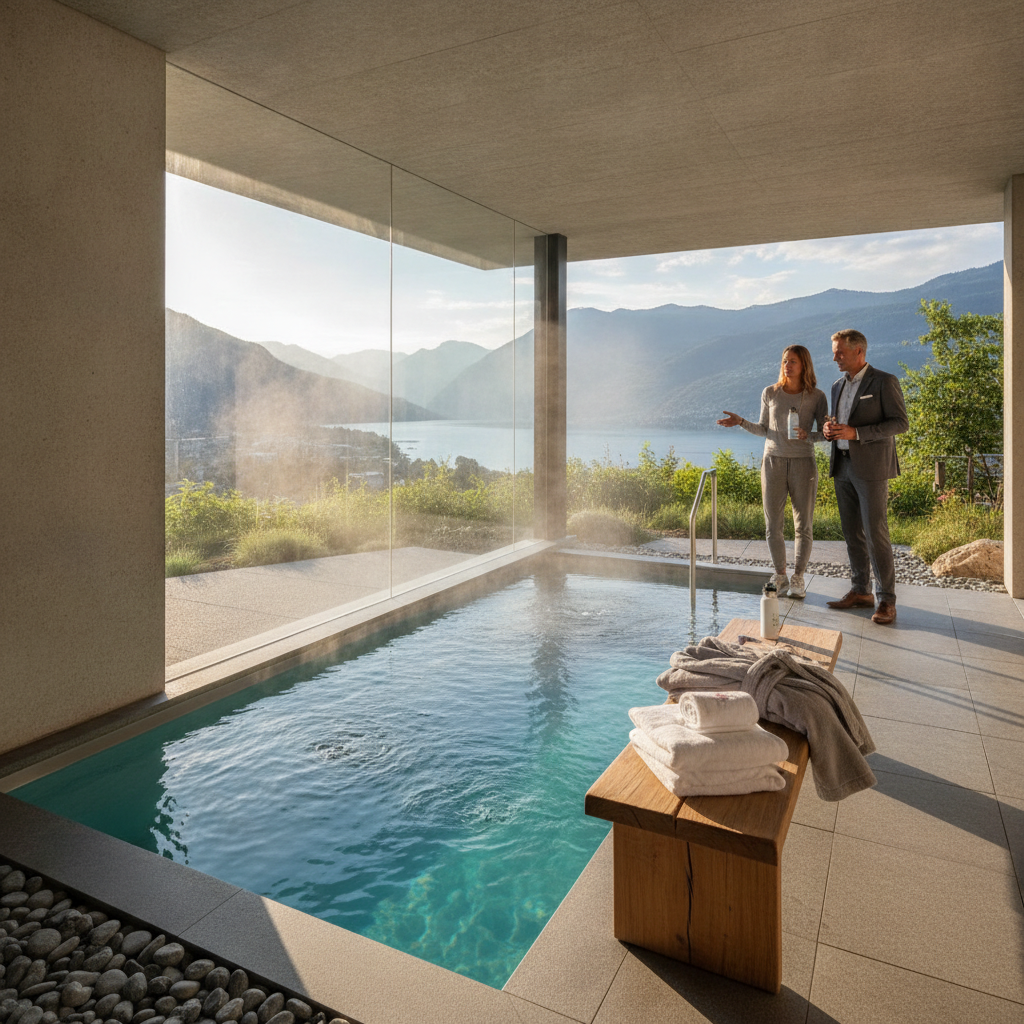
Marketing hotel cold plunge to guests is quickly becoming a line item that general managers, spa directors, and owners actually track, not just a spa amenity that sits quietly on a rate sheet. The equipment itself rarely drives bookings. The way a property frames, packages, and surfaces that equipment during the guest journey is what turns a cold plunge from a curiosity in the gym into a revenue source that guests ask for by name. This guide focuses specifically on the marketing side of the equation: positioning, packaging, booking visibility, language, and proof points, so a property can start converting interest into bookings without touching construction, plumbing, or electrical work.
TL;DR, The Bottom Line
Marketing hotel cold plunge to guests works best when the plunge is sold as an outcome (recovery, reset, a shared ritual) rather than as a piece of equipment, packaged with amenities guests already use, and made visible everywhere in the booking journey rather than buried on a spa subpage. Properties that lead with experience-based language, price the offer simply, and put recognition and real placements front and center convert more interest into actual bookings.
Quick Facts
- Setup time for the HomePlunge H3: about 5 minutes, using two insulated hoses over the rim of an existing tub
- Power requirement: a standard 110V outlet, drawing 9A, no electrical upgrade
- Cooling performance: tap water to 50°F in about 30 minutes, to 34°F in about 1 hour 20 minutes
- Unit price: $2,999 list price per unit, purchased once
- Pilot structure: one unit, one suite, 60 days
- Recognition: CES Innovation Award 2025 Honoree and a TIME Best Inventions special mention 2025
Why Marketing Hotel Cold Plunge to Guests Needs Its Own Strategy
Most hotels that add a cold plunge treat it like any other piece of gym or spa equipment: a line on the amenities page, a mention at check-in if a guest asks. That approach undersells it. Marketing hotel cold plunge to guests works differently because the amenity sells an experience and a feeling, not a specification sheet. Guests do not care that a chiller can bring water to 34°F. They care that they can end a travel day, a workout, or a ski morning with a reset that they cannot get at home or at a competing property down the street.
This matters more now because guest expectations around wellness have shifted. Travelers increasingly expect properties to offer structured recovery and thermal experiences, not just a pool and a treadmill. A property that treats its cold plunge as a hidden feature is leaving demand on the table that a slightly more deliberate marketing approach could capture. The goal of marketing hotel cold plunge to guests is not to convince people cold water is good for them. The goal is to make the experience easy to find, easy to understand, and easy to book.
What Guests Are Really Booking When They Choose a Cold Plunge
When a guest books a cold plunge experience, they are rarely booking the tub itself. They are booking one of a handful of outcomes: recovery after a flight or a workout, a structured ritual they can repeat daily, a shareable moment for a trip with friends or a partner, or simply a wellness activity that feels more interesting than another lap in the pool. Effective marketing hotel cold plunge to guests starts by identifying which of these outcomes matters most to the property's typical guest mix and leading with that language everywhere the amenity appears.
A ski resort property should lean into recovery after a day on the mountain. A golf resort should lean into recovery after eighteen holes in the heat. A city hotel near a marathon route or a convention center should lean into recovery after long days on foot or long flights. A boutique leisure property might lean into the shared ritual angle, framing the plunge as part of an evening wind-down rather than an athletic recovery tool. The equipment can be identical across all four properties. The marketing should not be.
No. The strongest approach to marketing hotel cold plunge to guests avoids medical or disease-related claims and instead focuses on recovery, refreshment, relaxation, and the ritual of the experience itself. Claims about immunity, metabolism, or guaranteed health outcomes should be avoided entirely.
Package the Experience: Building Offers Guests Will Actually Buy
One of the clearest lessons in marketing hotel cold plunge to guests is that standalone access rarely performs as well as a bundled offer. Guests respond better to a named package than to a menu item that simply says "cold plunge, 15 minutes." Stronger packaging options include:
- A sauna-and-plunge contrast circuit sold as a single session
- A massage-plus-plunge recovery add-on
- A fitness center recovery pass that includes plunge access after a workout
- A couples' thermal experience for leisure travelers
- A pre-arranged recovery booking offered at check-in for guests arriving from long travel
- Activity-specific packages for ski, golf, surf, race weekends, or cycling groups
These bundles do two things at once. They raise the average value of the booking, since guests are purchasing a combined experience rather than a single low-ticket item, and they give guests a clear reason to say yes instead of leaving them to guess whether a cold plunge alone is worth the trip to the spa desk. A property marketing hotel cold plunge to guests through a named package, such as "Reset Ritual" or "Recovery Hour," will almost always outperform a property that simply lists "cold plunge" on a price sheet next to a dozen other spa services.
Where to Place the Cold Plunge in Your Booking Funnel
A cold plunge cannot generate demand if guests only discover it after they arrive. Properties serious about marketing hotel cold plunge to guests make the amenity visible at every stage where a guest might be deciding whether to book, upgrade, or add a service. That includes the room-booking amenity list, the pre-arrival email, the spa booking page, the mobile app or guest messaging platform, and signage near the fitness center or pool.
A five-step approach to surfacing the amenity
- Audit every guest touchpoint where amenities currently appear, from the booking engine to the in-room directory, and note where the cold plunge is missing.
- Create one named package rather than listing the plunge as a generic line item, so it has a title guests can ask for by name.
- Add it to pre-arrival communication so guests can plan around it before they check in, not discover it by accident.
- Place signage at the point of use, near the gym, spa, or pool, so walk-by guests can book on the spot.
- Brief front desk and spa staff on a short, consistent script so every guest hears the same framing regardless of who checks them in.
Properties that complete all five steps tend to see the amenity treated as a real revenue opportunity rather than a feature that only comes up if a guest happens to ask. This is the operational backbone of marketing hotel cold plunge to guests: visibility has to exist before language and packaging can do their job.
Ideally in the room-booking amenity list itself, not only on a separate spa page, since many guests decide on add-ons before they ever browse the spa menu separately.
The Language of Marketing Hotel Cold Plunge to Guests: Words That Work
Word choice has an outsized effect on conversion for this amenity. Guests respond to language that describes a feeling or an outcome: "guided recovery session," "cold-water reset," "thermal circuit," or "post-workout recovery." They respond less to purely technical language such as temperature specifications or equipment brand names, which belong lower on the page for guests who want detail, not in the headline.
At the same time, properties should avoid overpromising. Marketing hotel cold plunge to guests should never lean on unsupported claims about immunity, disease treatment, metabolism, or guaranteed mental health outcomes. Language should stay anchored to experience: refreshment, relaxation, recovery, and ritual. This keeps marketing both effective and defensible, and it matches how most guests actually talk about the experience afterward, which tends to focus on how they felt rather than any clinical outcome.
A useful test for any piece of copy: would a guest repeat this phrase to a friend? "I did the cold plunge after my run and felt amazing" is something a guest says. "I experienced a 34°F immersion protocol" is not. The best marketing hotel cold plunge to guests campaigns are written the way guests actually talk, not the way a spec sheet reads.
Pricing and Operations: Keeping the Offer Simple for Guests and Staff
However a property prices its cold plunge offer, simplicity matters more than granularity. Guests respond better to a flat package price than to a menu with multiple duration tiers and add-on fees. Staff also deliver better service when there is one price to remember rather than five variations.
Operationally, the easiest cold plunge programs to market are the ones that are easiest to run. The HomePlunge H3 was built around that idea: it is a chiller on wheels that cools the water in a bathtub or spa tub the property already has, so nothing is installed and no plumber, electrician, contractor, or permit is required. Setup takes about five minutes, using two insulated hoses placed over the rim of the tub and a standard 110V outlet. The tub drains after each guest, so every stay starts with fresh water, and there is no sanitation chemical program to manage, since water is never shared or reused between guests. The reusable filter only needs rinsing every four to six weeks, and scheduling and temperature are controlled from an app.
That simplicity matters for marketing because a property can promise guests a consistent, ready-to-use experience without needing to explain complicated turnaround procedures. A guest who books a late-afternoon recovery session does not want to hear about plumbing logistics. They want to know the water will be cold and ready. Properties evaluating options can see how the HotelPlunge program works before committing to a pilot.
Using Proof and Recognition to Build Guest Trust
Guests are more willing to book an unfamiliar amenity when there is some external signal that it is credible, not just a property-level experiment. Recognition and real-world placements do this work without requiring a hotel to make bold claims on its own. The HomePlunge H3, the chiller used in HotelPlunge's hospitality program, has been named a CES Innovation Award 2025 Honoree, received a TIME Best Inventions special mention in 2025, and won Garage Gym Reviews' Best Indoor Cold Plunge recognition. It also has partnerships tied to the NFLPA, MLBPA, MLSPA, and PAC.
On the hospitality side, the equipment is in residence at Carillon Miami Wellness Resort and The Santaluz Club, and phase one was ordered by JW Marriott Desert Springs Resort & Spa. Properties marketing hotel cold plunge to guests can reference this kind of placement and recognition in guest-facing materials where appropriate, which gives skeptical guests a reason to trust the amenity without the property needing to make unsupported claims of its own.
A property that is still testing demand does not need a full rollout to start marketing the experience. A single-suite pilot, running one unit for about 60 days, is often enough to gather guest feedback, test package pricing, and refine the language before expanding further.
Common Mistakes When Marketing Hotel Cold Plunge to Guests
A few recurring mistakes show up across properties that struggle to generate bookings for this amenity.
- Burying the amenity on a spa subpage. If a guest has to click through three menus to find it, most will not bother.
- Leading with equipment specs instead of outcomes. Temperature and dimensions belong in the fine print, not the headline.
- Selling access alone instead of a package. Bundled offers consistently outperform a la carte listings.
- Inconsistent staff messaging. If the front desk, concierge, and spa team all describe the amenity differently, guests lose confidence in what they are booking.
- Overpromising health benefits. Claims that sound clinical or medical can create liability concerns and often do not match how guests actually experience the amenity.
Avoiding these mistakes is less about budget and more about discipline. Marketing hotel cold plunge to guests well is mostly a matter of naming the offer clearly, placing it where guests are already looking, and keeping the language consistent from the booking engine to the front desk script.
Frequently Asked Questions
What is the best way to start marketing hotel cold plunge to guests?
Start with a single named package, such as a recovery or reset experience, placed directly in the room-booking amenity list and pre-arrival communication, rather than only on a separate spa page.
Should a hotel bundle the cold plunge with other amenities?
Yes. Packages that combine the plunge with a sauna session, massage, or fitness recovery pass tend to convert better than offering plunge access on its own, since guests have a clearer reason to book.
What language should hotels avoid when marketing a cold plunge?
Avoid medical or disease-related claims, such as promises about immunity or guaranteed health outcomes. Focus on recovery, refreshment, relaxation, and the ritual of the experience instead.
Does a hotel need renovation to offer a cold plunge for marketing purposes?
Not with every system. The HomePlunge H3, used in HotelPlunge's hospitality program, cools water in a bathtub or spa tub the property already has, with setup taking about five minutes and no plumber, electrician, or permit required.
How can a property test demand before a full rollout?
A single-suite pilot running one unit for about 60 days is a common approach, allowing a property to test guest response and package pricing before expanding to additional rooms or the spa.
Bringing It All Together
Marketing hotel cold plunge to guests is ultimately about translation: turning a piece of recovery equipment into a named, bookable experience that fits naturally into how guests already plan their stay. Properties that lead with outcomes instead of specifications, bundle the amenity into offers guests already understand, place it visibly across the booking journey, and support it with credible recognition tend to see the strongest results. None of this requires a construction project or a complicated operational overhaul. It requires a clear package, consistent language, and a system simple enough that staff can deliver on the promise every time.
Properties ready to move from idea to pilot can learn more about HotelPlunge's hospitality program and see how a single-suite pilot can help refine the offer before a wider rollout.